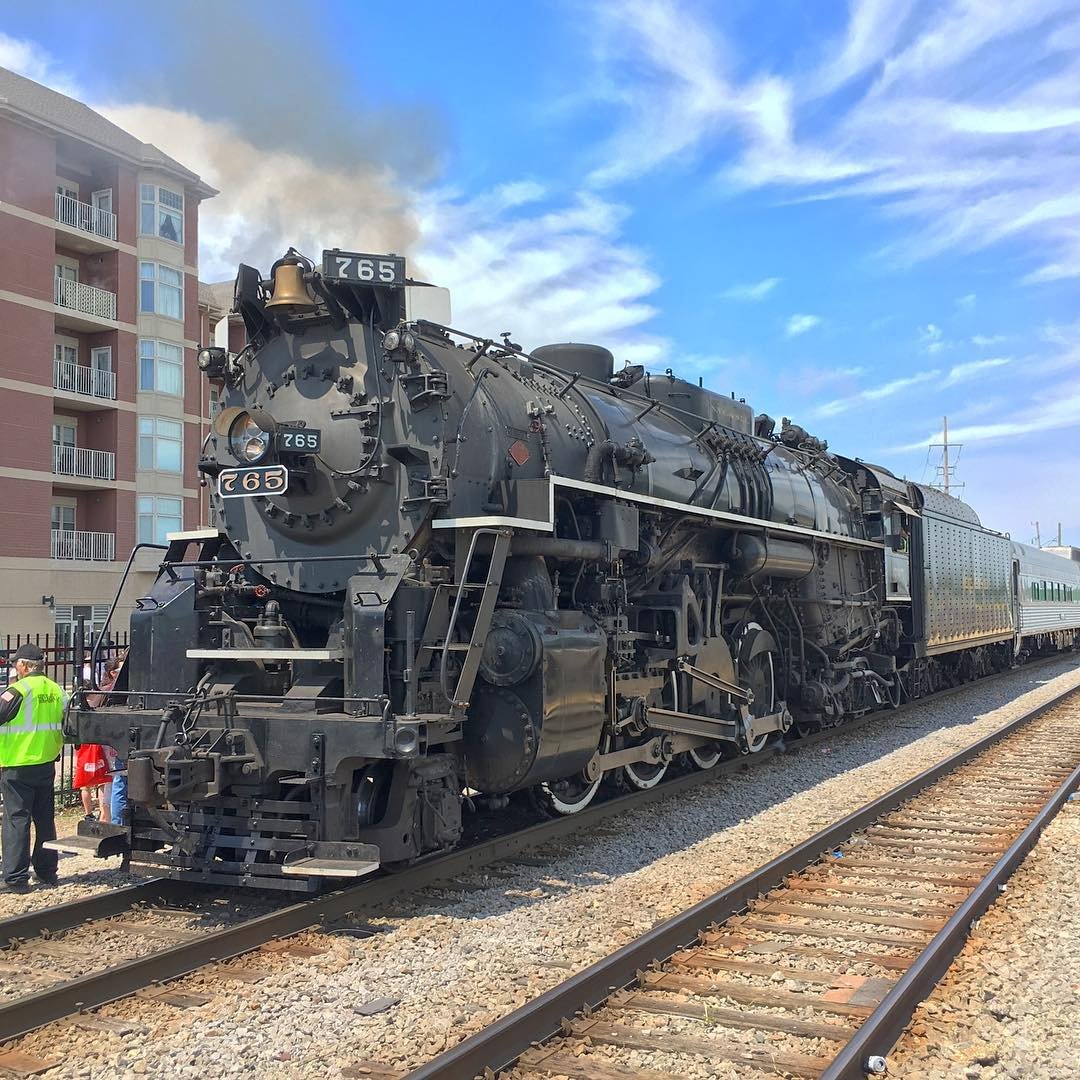

Chicago moves more freight by rail than any other city in North America. The country's major east-west and north-south rail corridors converge here, which means that at any given moment, an enormous share of everything shipped across the United States is passing through the Chicago region. And there's a spot in the northwest suburbs where you can stand still and watch all of it go by.
That spot is Franklin Park, IL, about 13 miles northwest of the Loop and a few minutes past O'Hare. Unless you've had reason to exit the highway there, you've likely passed through without registering it at all. Railfans know it well. Everyone else is missing one of the most concentrated train-watching locations in the country.
Four Railroads. One Diamond Crossing. No Waiting.
Most train-watching spots give you one railroad, maybe two. Franklin Park gives you four distinct operators sharing a tight geography: Canadian Pacific Kansas City (CPKC), Canadian National, Metra, and Indiana Harbor Belt (IHB). Each runs its own equipment, its own schedules, and its own mix of car types. On an active day, you're looking at 70 to 90 trains passing through.
That volume matters for a practical reason. Casual visitors don't want to wait 45 minutes for a train to show up. At Franklin Park, you're rarely waiting more than 10 to 15 minutes between movements. The action is consistent enough that you can show up, settle in, and within a few minutes understand why people come back repeatedly.
The physical reason for all this convergence is a diamond crossing: a point where a north-south rail line crosses an east-west line at grade level. Diamonds are increasingly rare. Railroads have spent decades building grade separations to eliminate them, because they create coordination requirements and potential bottlenecks. The one in Franklin Park is still active and watchable from the park adjacent to the police station on the northwest quadrant of the crossing. You're watching north-south Canadian National traffic cross east-west CPKC and Metra traffic: independent rail systems, physically intersecting, in real time.
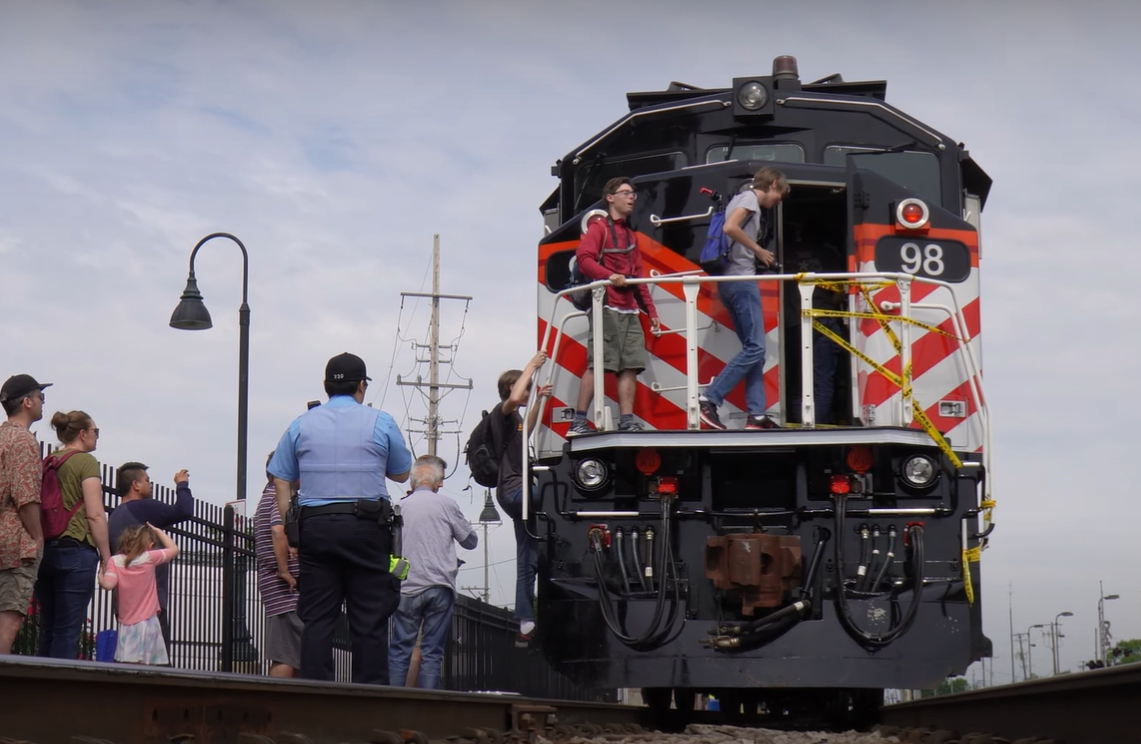
Train fans tour a parked Metra engine at the annual Railroad Daze in Franklin Park
The Railroad That Circles All of Chicago Starts Here
Ask most Chicagoland residents about Indiana Harbor Belt and you'll get a blank look. Ask any railfan and they'll tell you it's one of the most consequential short-line railroads in North America.
IHB operates in a semicircle around the Chicago region, connecting major freight railroads to each other and to the industrial yards along the lakefront and into northwest Indiana. It moves transfer cars between systems, serves customers along the line, and functions as the connective tissue that keeps Chicago's freight network moving. The railroad operates 320 miles of track including yards, serving as the interchange between carriers that would otherwise have no direct connection to each other.
Franklin Park is where the main Indiana Harbor Belt line begins. Its northern terminus is right here, at the CPKC Milwaukee District West line. When you watch an IHB locomotive working through Franklin Park, you're watching the start of a 320-mile arc that sweeps around the entire city and ends in Hammond, IN. Knowing that before you arrive reframes what you're looking at from "a freight train" to the beginning of something much larger.
A Ghost Logo and a Preserved Caboose
One block west of the Franklin Park Metra station, in a small park at Calwagner Street, there's an old interlocking tower. It says "Milwaukee Road" on the side. The Milwaukee Road railroad ceased to exist in 1986.
Tower B-12 was built in the 1890s to control train movements at the crossing where the Milwaukee Road met the IHB tracks. An operator inside would pull manual levers to route trains onto the correct tracks and prevent collisions. The tower closed permanently in July 1996, was relocated to its current position in 1997, and has been part of a small railfan park ever since, alongside a preserved Milwaukee Road caboose. Visitors who spend a few minutes inside the park typically come away with a clearer sense of how much coordination a busy junction like this one required before computerized dispatch.
The tower is a useful anchor for understanding Franklin Park's place in railroad history. This was never a town through which trains happened to pass. It was a control point, a junction that required human oversight and a dedicated structure to manage the complexity of what was happening here. Franklin Park wasn't just on the railroad. It was where the railroad was managed. The logo on the tower belongs to a railroad that no longer exists, now operating under CPKC. That kind of layered history shows up in almost every detail of the place if you know where to look.
Scanner Frequencies, Sightlines, and Where to Stand
There are two primary watching spots. Tower Park at Calwagner Street gives you comfortable access to the east-west mainline, with the tower and caboose providing context and a bit of shade. The park next to the Franklin Park Police Department at 9545 West Belmont Avenue gives you the best angle on the diamond crossing itself, though fencing limits the sightlines somewhat. Experienced spotters often start at Tower Park for freight on the main line, then walk over to Belmont for the crossing action.
If you want to monitor radio traffic before trains appear, the scanner frequencies for all four railroads operating here are publicly available: CPKC and Metra run on 161.520, Canadian National uses 160.920 for road traffic and 161.295 for dispatcher communications, and IHB operates on 160.980. A basic handheld scanner picks up all of these and turns the experience from passive to interactive. You'll hear a train called in before it arrives.
Both Metra stations in Franklin Park are served by the Milwaukee District West line, with direct service from Chicago Union Station. You can get here without a car, which matters for anyone coming from the city who'd rather not deal with parking near an active rail yard.
Your First Visit Won't Be Your Last
If you've never watched trains deliberately before and you're not sure why anyone would, Franklin Park is the right place to find out. The traffic volume means you won't be standing around wondering if something will happen. Something is always happening.
What tends to click for first-time visitors is the scale. A freight consist rolling through Franklin Park is often 100 cars long, pulled by multiple locomotives, carrying goods that will reach the East Coast or Gulf Coast within 48 hours. Standing next to that at grade level, close enough to feel the air displacement as it passes, is a different experience than seeing a train from a highway overpass. The diamond crossing adds another dimension: two independent rail systems negotiating shared physical space in real time, a kind of infrastructure choreography that most people never see up close.
Weekdays offer the most consistent freight volume, with fewer commuter crowds on the platform. Mornings are typically the most active window. Bring something to sit on if you're planning to stay longer than a few minutes. And if you want to understand what you're watching, spend five minutes reading about the Indiana Harbor Belt railroad before you arrive. It changes what you see.
Tamales at 4 A.M. and the No. 1 Hot Dog in America
It’s worth arriving hungry to Franklin Park and its immediate neighbors. Two stops in particular belong in your plan.
 Aracely's Bakery
9667 West Franklin Avenue, Franklin Park
Aracely's Bakery opens at 4:00 a.m., which makes it one of the few places in the suburbs where you can get a tamale and a horchata latte before the morning freight rush starts. The family-owned bakery has been operating since 1982, and it draws people from well outside the Franklin Park area. Reviewers regularly mention driving in from Elgin specifically for the tamales, which have taken top honors at Chicago tamale competitions. The green chicken tamale is the signature order; arrive before 10 a.m., as they sell out. Its conchas are also consistently ranked among the best pan dulce in the northwest suburbs.
.jpg?width=270&height=270&name=163383592_454039559148993_5743070906706729162_n%20(1).jpg) Gene & Jude's
Gene & Jude's
2720 North River Road, River Grove
Gene & Jude's is technically in River Grove, about a mile from Tower Park, but don’t let that stop you from visiting. The stand has been at this location on North River Road since 1950, and Serious Eats has ranked it the No. 1 hot dog in America. The menu is deliberately short: hot dogs, double dogs, tamales, and fries that are cut from fresh potatoes daily. There’s no ketchup, no seats. What they call the Depression Dog comes with mustard, onions, relish, sport peppers, and fresh-cut fries piled directly on top of the hot dog inside the bun. It is entirely different from what most people picture when they think of a hot dog. Gene & Jude's was inducted into the Vienna Beef Hot Dog Hall of Fame in 2006.