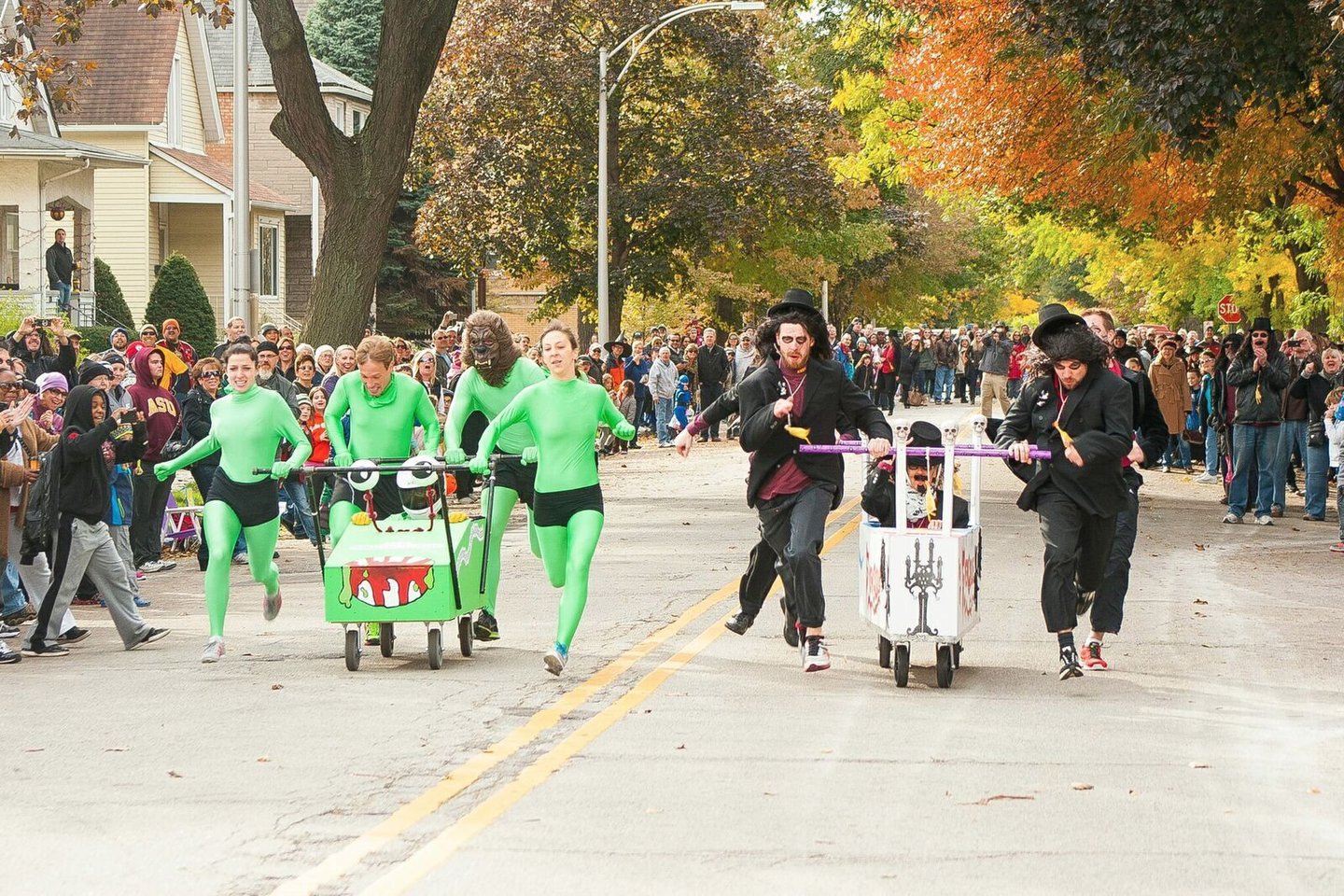

Every October, four-person teams push coffin-shaped carts down a closed block of Beloit Avenue in Forest Park, Illinois, while a costumed "ghost" rides inside. The event is called the Forest Park Casket Races, and it exists because Forest Park has spent generations known as the Village of Cemeteries.
Few towns would build a street race around that kind of identity. Forest Park did.
Casket Races at a Glance
-
Where: Beloit Avenue between Madison and Adams Streets in Forest Park
-
When: Annually in mid- to late October
-
Cost: Free to watch; team registration requires a fee
-
Who races: Five-person teams, with four runners pushing and one “ghost” riding inside
-
Afterward: Trick-or-treating on Madison Street typically follows the races
-
Before you go: Confirm this year’s race date, schedule, and registration deadline with the Forest Park Chamber of Commerce & Development
Only Forest Park Could this Pull Off
Forest Park sits on roughly 1.5 square miles of land, and a defining share of it is cemetery. The cluster of major historic cemeteries includes Forest Home, Concordia, Woodlawn, Waldheim/Jewish Waldheim, and Altenheim. Together, they hold the remains of hundreds of thousands of people in a village with about 14,000 living residents.
Locals call it the Village of Cemeteries, and the Forest Park Chamber of Commerce made that nickname the centerpiece of its biggest annual event.
The race originated in 2012, when chamber executive director Laurie Kokenes was planning the chamber's 100th anniversary and looking for a Halloween event that fit the village's identity. She found that Manitou Springs, Colorado, already held coffin races tied to a local ghost story and recognized the fit immediately. "That's so Forest Park," she said.
The chamber also tried a masquerade ball, a Zombie Pub Crawl, and an event called Ghoulin' in the Grove in those early years. All three fell away once it became clear that the Casket Races and the Trick or Treat that follows on Madison Street were the events people actually wanted.
Kokenes has said the idea faced some resistance at first, but most Forest Park residents loved the concept and ran with it. The race has been held every fall since, growing from a handful of entries into one of the largest Halloween draws in Chicago's western suburbs.
The race takes place on Beloit Avenue between Madison and Adams Streets in downtown Forest Park, a few blocks from the CTA Blue Line's Forest Park stop and an easy walk from Madison Street parking. Organizers typically hold the race on a Saturday in mid- to late October. The Forest Park Chamber of Commerce & Development posts the exact dates, team registration information, and the day's schedule on its website each year.
Watching is free. Entering a team costs a registration fee, and the chamber does not accept race-day sign-ups, so any team planning to build a casket should register well in advance. Anyone curious about Forest Park's cemetery history beyond the race itself can look into the Historical Society of Forest Park's cemetery tours, which dig into the same "Village of Cemeteries" identity the race was built to celebrate.
How the Casket Races Work
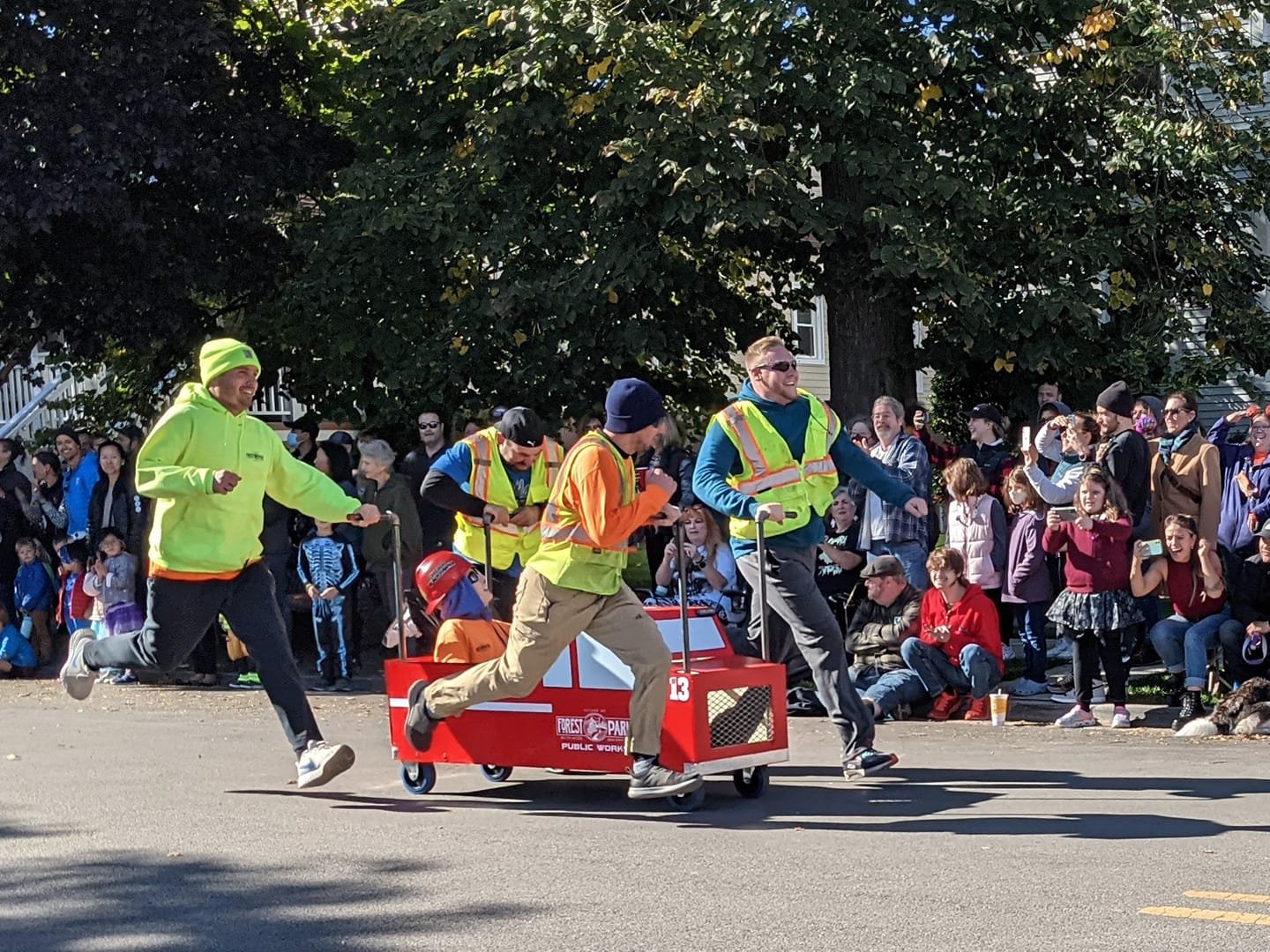
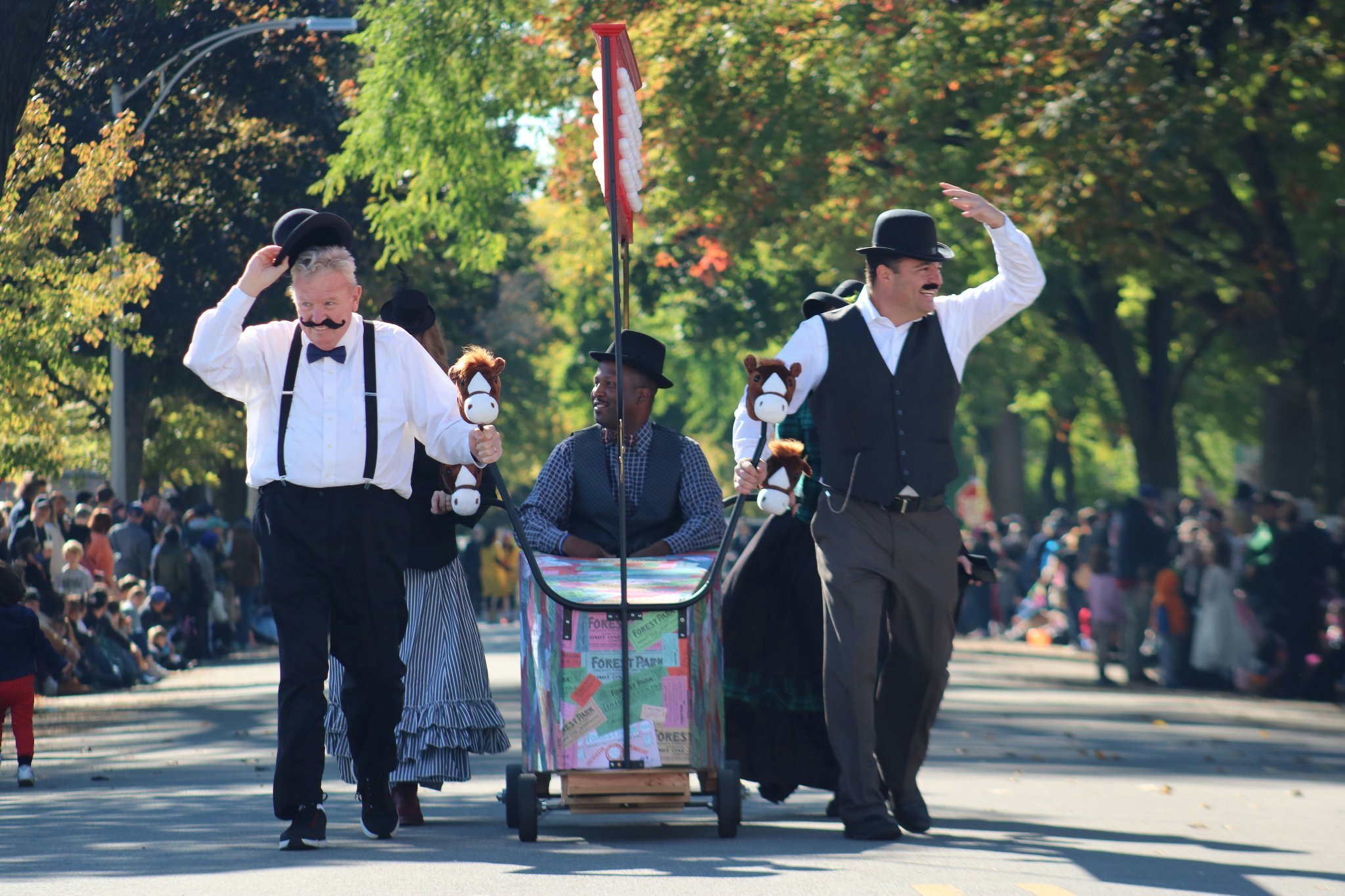
Every casket has to follow the same four rules: four handles, four wheels, no steering mechanism, and a seat for the rider. Five teammates compete per entry: four runners pushing and one "ghost" riding inside, usually wearing a helmet.
Each team runs the course twice to post a qualifying time over the one-block, 585-foot stretch of Beloit Avenue between Madison and Adams. The four fastest qualifiers advance to a final heat, where first, second, and third place are decided in a matter of seconds.
Recent races have drawn roughly 20 teams, typically fielded by local businesses, schools, nonprofits, and neighborhood groups. Trophies go out for first, second, and third, plus separate awards for the creepiest casket and the most frighteningly funny one. The slowest team of the day takes home the "Dead Last" trophy, which locals treat as being just as worth winning.
The course is short enough that each race is over almost as soon as it starts. Spectators come for what surrounds the sprint: the builds, the costumes, the team names, and the crowd packed two and three deep along both curbs.
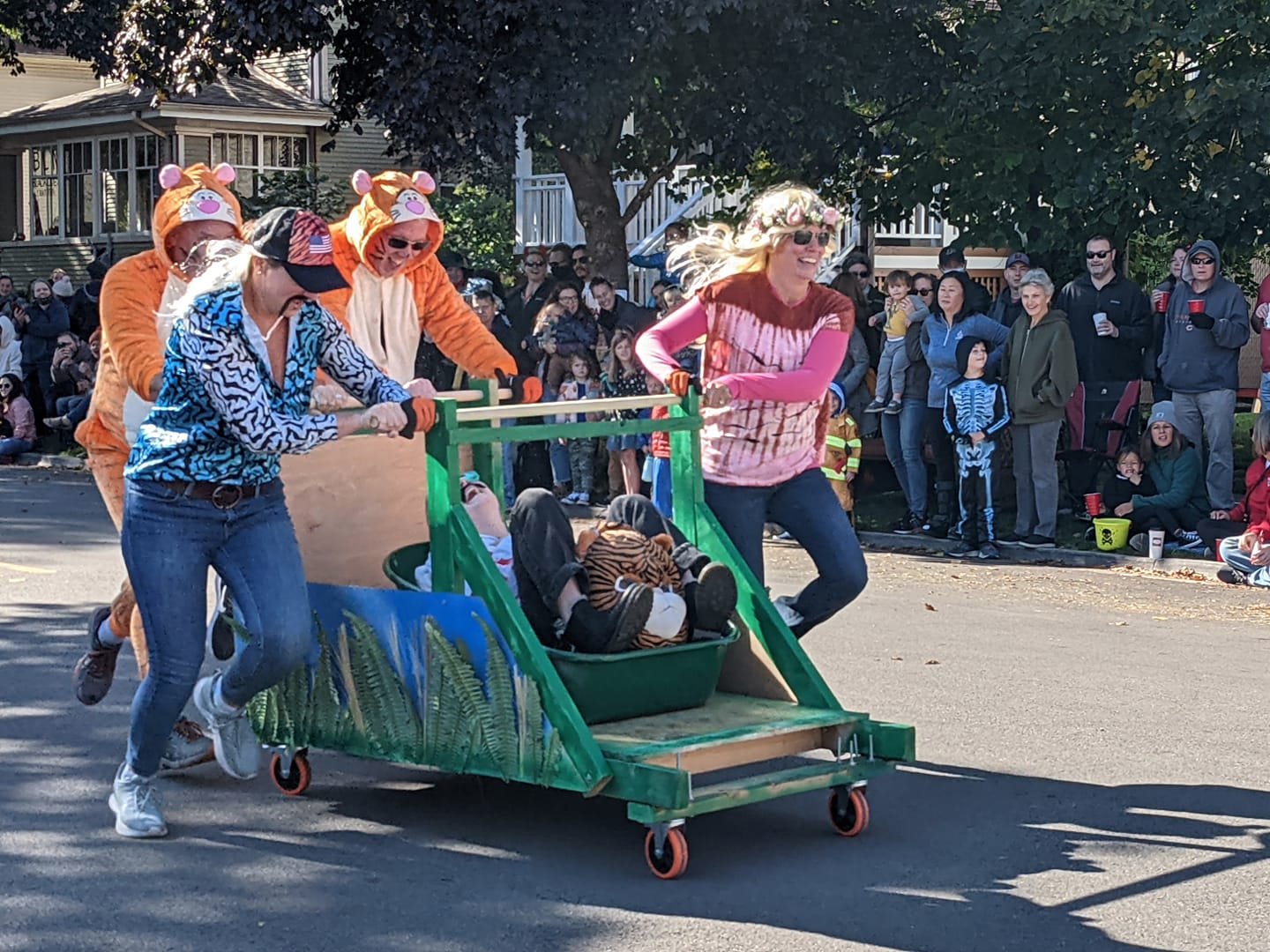
Decoration is where the event earns its reputation. Some teams build something simple and durable that can survive several years of races; others go all out for a single year and never repeat it. One year, Schauer's Hardware partnered with a local ice sculptor to build a roughly 600-pound ice casket, fully aware it was not going anywhere fast. They had it delivered by tow truck and raced it anyway.
Riveredge Hospital has fielded a team of flying monkeys one year and a Día de los Muertos–themed "creepiest casket" winner another. Other past entries have leaned into pop culture, horror movies, and local in-jokes in equal measure, and team names tend to be as notable a part of the entry as the casket itself.
The judging for creepiest and funniest happens before the racing starts, during the Parade of Caskets, when every entry rolls down the route so that the crowd and judges can get a good look before the heats begin.
The race itself takes up only one block of Beloit Avenue, but the event around it has grown well past that. Houses along the route regularly host informal viewing parties, common enough that the chamber added a best house-party award to recognize them.
Local vendors often set up along the route with coffee, pastries, breakfast food, and snacks. The day frequently includes a costume parade for kids and pets between heats, so the lull between races has its own built-in entertainment.
It is one of those local events where the competition matters, but not as much as the commitment to the bit. The teams are trying to win, but they are also trying to make people laugh, make people stare, and build something strange enough to be remembered the next year.
After the Race
The day typically wraps with Trick or Treat on Madison Street, where the same crowd that just watched the races moves a few blocks over to the village's main commercial strip for candy and an early look at Halloween storefronts. It is a short walk from the race course and the best reason not to leave Forest Park as soon as the trophies are handed out.
For a casual post-race meal, FatDuck Tavern & Grill sits on the corner of Elgin Avenue and Madison Street and is known for the duck-fat fries that give it its name. The DuckFat Burger, served with brie, applewood bacon, and caramelized onion, is the move if you want something hearty after standing outside on an October morning.
O'Sullivan's Public House, at 7244 Madison Street, is a good stop for anyone who wants the day to turn into a longer Forest Park hang. The pub occupies a converted 1890s roadhouse, with the original copper ceiling and terrazzo floor still intact. A fireman's pole salvaged from an old Chicago firehouse now serves as a footrest at the bar, and the all-season beer garden has a retractable roof, which matters given that October weather in Chicago is never a sure thing.
For families, The Brown Cow Ice Cream Parlor, at 7347 Madison Street, is the easy reward stop. It operates inside a theater building constructed in 1886, scooping house-made ice cream and baking its own pies and cakes on site.
Forest Park did not invent the coffin race. It just decided, more than most other towns would, to own what makes it different.