
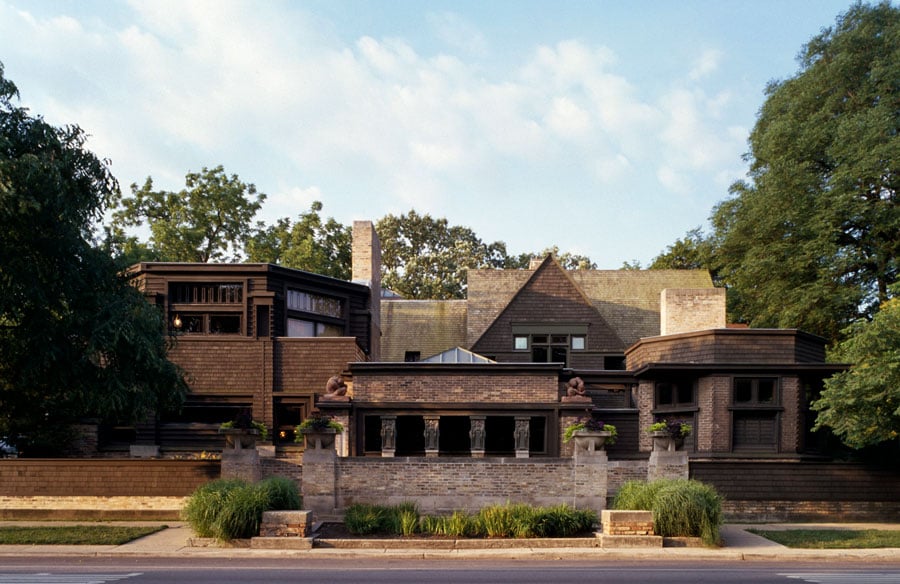

Just nine miles west of downtown Chicago, on a quiet residential corner in Oak Park, sits the place where Frank Lloyd Wright changed American architecture. In the Frank Lloyd Wright Home and Studio, he refined the ideas that would become the Prairie School and organic architecture while designing more than 100 works that still feel strikingly modern today.
Take the tour and you’re not just walking through a historic house museum; you’re stepping into the very place where Wright’s vision took shape. This post will walk you through the early days of the home, what to expect on a visit, how to plan your tour, and how to make the most of the incredible architecture woven through the surrounding Oak Park neighborhood.
Meet Frank Lloyd Wright
An American architect who helped define 20th-century design, Frank Lloyd Wright (1867–1959) is best known for his Prairie School houses, his organic architecture philosophy, and landmark works from Chicago all the way to Arizona. In Oak Park, IL, he turned his own shingle-style Oak Park home into a family home, a design lab, and a house museum in the making, laying the groundwork for the Prairie style that would reshape residential architecture.
If you’re new to his story, a few quick highlights make the Oak Park visit click into place:
Wright’s early career unfolded in Chicago, where he worked as a draftsman and then head designer for the firm Adler & Sullivan, learning under Louis Sullivan, whose influence can still be felt in Wright’s design language.
While at Adler & Sullivan, he secretly designed bootleg houses in Oak Park and Chicago, a side practice that led to a break with Sullivan and the launch of his own office.
Wright became the leading figure of the Prairie School, favoring low horizontal lines, open plans, and homes that seemed to grow out of the Midwestern landscape as a distinctly American answer to ornate Victorian styles.
His idea of organic architecture meant that the building and its interiors, furnishings, glass windows, and site all worked together as a unified whole, a philosophy visitors can still feel in Wright buildings across Chicago and beyond.
Frank Lloyd Wright’s Home and Studio
The Original Oak Park Home
Frank Lloyd Wright’s Oak Park home began in 1889 as a modest shingle-style house on Chicago Avenue for Wright, his wife Catherine, and the growing Wright family. Financed in part by a loan from Louis Sullivan, the Oak Park residence evolved over the next 20 years as FLW tested new ideas, gradually transforming the structure into an early expression of Prairie style.
Inside, visitors can see how he shifted from Victorian coziness to open-plan living by linking the living and dining rooms with flowing sightlines, carefully placed hearths, and inglenook seating. Broad overhanging roofs, strong horizontal bands of glass windows, art-glass motifs, and earth-tone materials hint at Wright’s later iconic designs such as Robie House in Chicago and Heurtley House in the Oak Park Historic District.
The Studio Addition
In 1898, Wright added the Oak Park studio wing to formalize his growing practice, turning his home on Chicago Avenue into the official Frank Lloyd Wright Home and Studio that anchored his work for about two decades. This studio functioned as both office and laboratory. Today guided tours trace how Wright’s design team developed many of the early Prairie School houses in Oak Park, River Forest, and across Illinois.
The most dramatic space is the two-story, octagonal drafting room, featuring a barrel-vaulted space ringed by a balcony suspended from chains, with hanging fixtures, skylights, and tall glass windows that flood the second floor with soft light. Nearby, visitors step through the reception hall into Wright’s private office and small library, spaces that show how he blurred home and work long before blending life and work became a trend.
Family Life Inside Wright’s Living Laboratory
For all its architectural firsts, this was still the Oak Park home where Wright, Catherine, and their six children lived everyday life. The dining room and adjacent playroom became some of his earliest “total” interiors, where furniture, art glass, and lighting were all part of Wright’s design vision.
Up on the second floor, the children’s playroom is a showstopper: a barrel-vaulted ceiling with skylights, a central hearth, built-in seating and storage, and low glass windows scaled to kids, all arranged as an early, child-centered environment. Today, the Frank Lloyd Wright Trust’s guided tours highlight these intimate spaces, helping first-time visitors see how what is now a National Historic Landmark could also function as a warm family home.
What to Expect on a Home and Studio Tour
How Tours Work
The Frank Lloyd Wright Home and Studio is operated by the Frank Lloyd Wright Trust, and interior access is available only on guided tours booked through flwright.org.
Most tours run about 60 minutes, with small groups led by trained docents; timed tickets are highly recommended—especially on weekends and in peak seasons—so it’s smart to purchase online in advance.
Spaces You’ll See
In the house, you’ll move room by room through the entry hall, living spaces, dining room, and second-floor playroom, where you can see early Prairie style flow, built-ins, art glass, and carefully choreographed light.
In the studio wing, the tour usually includes the reception area, Wright’s office, and the dramatic two-story, octagonal drafting room with its balcony, hanging chains and lights, and skylights.
What’s Typically Highlighted
As you walk through the rooms, you receive an insider’s take from guides who know the building’s quirks, backstories, and details. Docents often share how Wright used the house as an architectural laboratory, point out tiny things most visitors would miss—like subtle art-glass patterns or changes from one renovation to the next—and weave in stories about the Wright family and the major projects sketched in this studio.
The Feel of the Experience
The tour feels a bit like stepping into Wright’s mind, because you’re seeing both the family house and the design lab where his 20th-century ideas were born. It’s a structured experience rather than a free-roaming house museum. You move with your guide in a small group (typically 15 or 16 people) at an easy walking pace that enables first-time visitors to catch the stories and details in each space.
Planning Your Visit: Logistics and Tips
Tickets, Timing, and Seasonality
Timed tickets sell out regularly—especially on weekends and in the spring through fall—so it’s best to reserve your spot through the Frank Lloyd Wright Trust website before you arrive. Hours and specific tour offerings can vary by time of year, so always double‑check the current schedule; for the best light inside the house and on a walking tour of the neighborhood, aim for a morning or late‑afternoon slot.
On‑Site Practicalities
Nonflash photography is generally allowed for personal use on Trust tours, but tripods, professional gear, and commercial shoots require advance permission. Because the Home and Studio are preserved as a National Historic Landmark, not every area is fully accessible; the Studio and the museum shop are ramp‑accessible, while the house and some stairs are not, so visitors with mobility needs should review the Trust’s accessibility information or contact guest services before booking. On-site you’ll find a small museum shop, restrooms for ticketed guests, and basic rules about bags and coats to help protect the narrow passages and original finishes.
Ticket Options and Bundles
The classic choice is the Guided Interior Home and Studio Tour, but many visitors also opt for the Inside and Out Experience, which pairs the docent‑led interior visit with a self‑paced outdoor audio tour of the surrounding Oak Park Historic District. Through the Frank Lloyd Wright Trust, you can often combine your Oak Park visit with other Wright sites—such as Robie House in Chicago and Oak Park’s Unity Temple —by booking multiple tours or special packages in a single itinerary.
Wright’s Oak Park Open‑Air Museum
Step outside the Frank Lloyd Wright Home and Studio and you’re in one of the highest concentrations of Wright buildings anywhere in the world, within the Frank Lloyd Wright–Prairie School of Architecture Historic District. Forest Avenue, Chicago Avenue, and nearby streets are lined with early Prairie style and transitional works that show Wright’s designs evolving from their Victorian roots into a new American language.
Ways to Explore the Area
As previously mentioned, the Trust’s Inside and Out option pairs your guided interior Home and Studio tour with a self‑guided outdoor audio tour that leads you past nearby Wright homes and related buildings, turning the neighborhood into an open‑air walking tour you can complete at your own pace. It’s a great way to see how the exteriors, streetscape, and mature trees complete the Prairie School vision you’ve just experienced inside.
Several organizations, including the Chicago Architecture Center, offer guided “Frank Lloyd Wright in Oak Park” walking tours that cover nearly a dozen or more structures in about an hour. These walks typically highlight not just the buildings but also the neighborhood history and how Oak Park helped shape Wright’s career and the broader Prairie style movement.
How Much Time to Allow
If your schedule is tight, plan on adding at least 30–60 minutes of neighborhood walking after your Home and Studio tour to see a few nearby houses on Chicago and Forest Avenues. Architecture fans will want to spend closer to a half‑day in Oak Park—enough time for the interior tour, an outdoor audio or guided walking tour of the neighborhood, and maybe a stop at another Wright site in the area.
FAQ Frank Lloyd Wright Home and Studio
How long does the tour take?
The standard guided Frank Lloyd Wright Home and Studio tour is about 60 minutes; plan extra time to browse the museum shop and walk the surrounding neighborhood.
Can I tour the interior without a guide?
No. Interior access to the Home and Studio is available only by guided tour, both to protect the historic spaces and to provide interpretation.
Is photography allowed inside?
Personal, nonflash photography is generally allowed on Frank Lloyd Wright Trust tours, but video and audio recording, tripods, selfie sticks, and commercial photography require advance permission or are restricted.
Is the site family‑friendly?
Yes. The site is popular with families, but tours are structured and last about an hour, so it helps to prepare younger kids; the children’s playroom is often a highlight for school‑age visitors.
Is it accessible?
Accessibility is limited by the historic structure: The studio, drafting room, and shop are accessible via ramp, but the home and some stairs and balconies are not; visitors with mobility needs should review the Trust’s current accessibility details before booking.
Can I combine this with other Wright sites?
Yes. Through the Frank Lloyd Wright Trust you can also book tours of Robie House, Unity Temple, and other Wright sites in the Chicago area, either on the same day or as part of a broader itinerary.
Do I need to know a lot about architecture beforehand?
Not at all. Docents present Wright’s ideas and the history of the house in accessible language, so the tour works equally well for novices and serious architecture fans.
How to Make the Most of Your Visit
A visit to the Frank Lloyd Wright Home and Studio is the best way to see Wright’s early ideas in action, standing in the rooms where he tested concepts that helped shape modern architecture. Book a guided tour, leave time to wander Oak Park’s open‑air museum of Prairie style homes, and treat the experience as both a design lesson and a rare glimpse into Wright’s daily life with his family in the neighborhood that launched his career.